Understanding the width of a Dish Drying Rack is important when planning your kitchen layout, choosing countertop accessories, or customizing storage around a sink. This article focuses on explaining common width options, how capacity changes with size, and how customization works in real manufacturing environments. As a producer of stainless steel dish racks, ZHENGYONG offers flexible sizing options, including fully customized widths through our stainless steel dish drying rack series.
Dish drying racks come in a wide range of sizes because kitchens vary significantly—from compact apartments to large professional kitchens. Although styles differ, several width categories appear repeatedly across the market due to practicality and ergonomics.
Most countertop racks fall between 30 cm and 45 cm wide. This range is easy to place beside a sink and offers enough space for everyday dishwashing.
30–35 cm width is usually designed for single-person or couple households.
40–45 cm width works well for families requiring additional space for bowls, plates, and utensils.
Multi-layer racks often expand to 50–60 cm width, using vertical space rather than occupying extensive countertop area. Their added width supports more plates and can integrate cup holders or cutlery compartments.
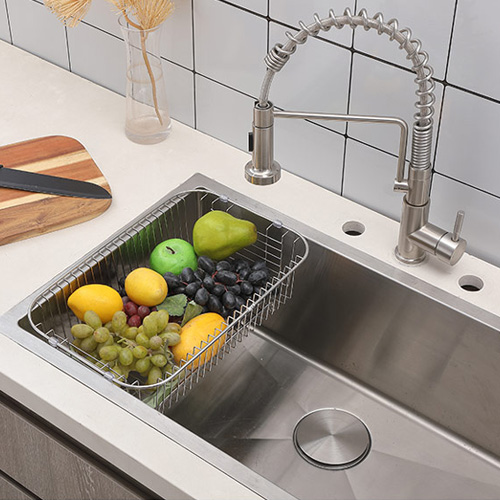
Over-sink models vary the most and typically range from 55 cm to 85 cm depending on sink width. These are practical for small kitchens because they free up countertop space. Many manufacturers design extendable frames to match customers’ sinks.
Racks intended for installation inside wall cabinets often follow cabinet standards:
Common cabinet widths: 60 cm, 70 cm, 80 cm, 90 cm
Dish racks are built slightly narrower to allow hinge clearance and mounting brackets.
Manufacturers can adjust rack width based on both structural and functional requirements. ZHENGYONG, for example, produces high-precision stainless steel racks with dimensional tolerance around ±2 mm, meaning custom measurements remain accurate and reliable in kitchen installations.
When customizing width, customers typically provide:
Sink inner width
Cabinet inner width
Desired capacity (number of bowls or plates)
Whether accessories such as chopstick holders are needed
The preferred installation type (hanging, countertop, cabinet-mounted)
Our dish drying rack series supports custom widths from 30 cm up to 90 cm, depending on model and use scenario.
Below is a helpful reference chart summarizing approximate capacity based on rack width. The actual capacity varies depending on plate thickness, bowl height, and whether the rack includes multi-layer storage.
| Rack Width | Approx. Plates | Approx. Bowls | Notes |
|---|---|---|---|
| 30 cm | 6–8 plates | 3–4 bowls | Suitable for small kitchens |
| 35–40 cm | 10–12 plates | 5–6 bowls | Most common household size |
| 45–50 cm | 14–16 plates | 7–8 bowls | Good for families |
| 55–60 cm | 18–20 plates | 8–10 bowls | Often multi-layer |
| 70–85 cm | 22+ plates | 12+ bowls | Best for over-sink or cabinet use |
ZHENGYONG’s stainless steel drying racks use durable stainless steel frames that maintain structural stability even in wider sizes, avoiding bending or deformation even under heavy load.
Width is not the only measurement that affects usability. Several other elements also matter when selecting or customizing a dish drying rack.
A wider rack can provide more capacity, but depth determines how stable the dishes stand. Greater height allows multi-tier designs but must remain within ergonomic reach.
Homeowners often measure countertop depth incorrectly. Part of the rack may overhang the sink area, which is acceptable as long as drainage paths are properly designed.
Hanging dish racks have stricter width limits because the supporting frame must align with anchor points or cabinet walls.
Deeper Asian-style bowls require more spacing. European-style flat plates may fit more densely. Custom width allows optimization for specific tableware types.
Yes. Stainless steel racks are easy to customize precisely. ZHENGYONG can manufacture racks based on customer measurements with very tight tolerance control.
Heavier items may require extra support bars or reinforced frames. Wider racks can still be safe when designed correctly with stainless steel and reinforced welds.
You can choose a slimmer rack (around 30–35 cm) or use an over-sink model that does not occupy countertop space.
Yes. They must match cabinet interior width minus a small allowance (typically 1–2 cm). This is why custom orders are common for cabinet-mounted racks.
Not always. Wider racks hold more dishes, but they also require more space and may reduce kitchen movement efficiency. The best width is the one that perfectly matches your sink or cabinet.
The width of a dish drying rack varies significantly depending on design type, kitchen space, and user needs. From compact 30 cm racks to large 85 cm over-sink models, each size serves a specific function. For customers seeking precise measurements and strong load-bearing reliability, stainless steel racks—especially customizable options like ZHENGYONG’s dish drying rack—provide stable, long-lasting solutions.
Choosing the right width involves understanding capacity, installation type, and everyday usage habits. With customization available across a wide range of dimensions, homeowners and commercial kitchens can always find or design a rack that fits perfectly.