stainless steel sink grids from China can be very good quality, but only when the product is built with the right material, precise welding and forming, a consistent finish, and a repeatable quality control system. A sink grid is a high contact accessory that protects the sink bottom from scratches, improves drainage, and supports cookware weight every day. Because it sits in a wet, detergent-rich environment, small differences in stainless grade, edge finishing, and foot material show up quickly as rust spots, wobble, noise, or poor fit.
This article explains what determines real quality for China-made sink bottom grids, how to evaluate suppliers, what specifications matter for project buyers, and how ZHENGYONG controls consistency for export programs. You can review our options on the stainless steel sink bottom grid page.
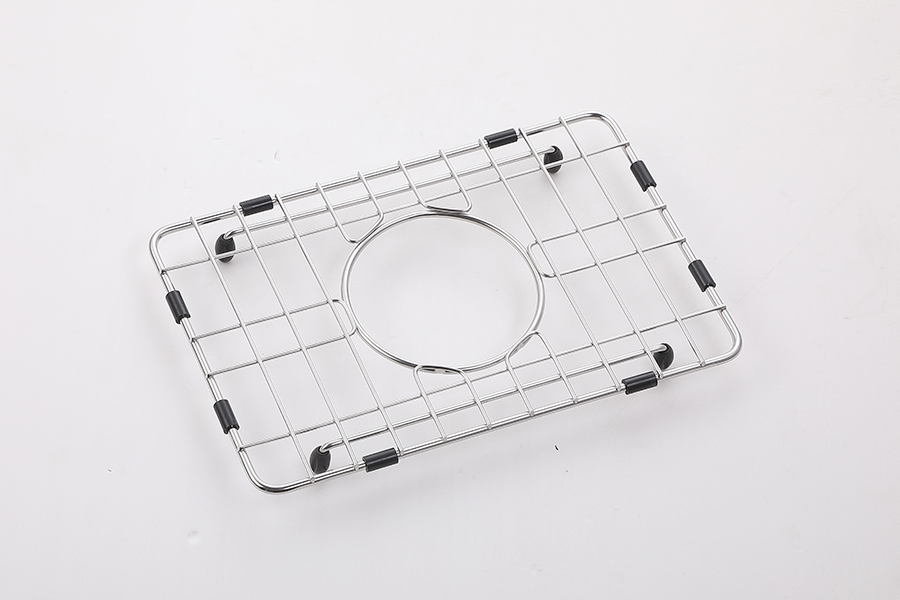
A good sink grid should sit flat, match the sink shape precisely, and keep cookware slightly elevated so water drains instead of pooling under pots. The wire layout should be strong enough to resist bending, while the surface should be smooth so it does not trap food residue or scratch delicate sink finishes. Quality is also about daily experience. A grid that shifts when you place a pan, or one that leaves black marks from unstable feet, will be rejected by users even if it looks fine on day one.
In production terms, quality comes from stable dimensions, clean welded joints, safe edges, and a protective finish that holds up to repeated washing and abrasion.
China has a wide range of manufacturing capability. The difference is not the country of origin, but the factory’s process control and inspection discipline. Sink grids are made from wire or flat stainless components that must be formed, welded, polished, and assembled with feet. If any step is inconsistent, the finished grid can warp, rock, or develop corrosion at weld points.
High-performing suppliers control three areas tightly.
First is material sourcing and traceability, so the stainless input remains consistent. Second is forming and welding consistency, so the grid stays square and stable under load. Third is surface treatment and final inspection, so burrs and weak spots are eliminated before packing.
A sink grid is constantly exposed to water, detergent, and acidic food residue. Stainless steel is chosen because it resists corrosion and is easy to clean, but the final finish determines how well it stays that way. Smooth finishing reduces water retention and makes the grid easier to rinse. A controlled polishing process also reduces micro-roughness that can hold stains and odor.
ZHENGYONG sink grids commonly use electrolytic polishing as a finishing method because it supports a clean surface feel and consistent appearance across batches. For buyers building a long-term program, surface consistency is often as important as strength because it affects consumer perception and reduces return complaints.
A sink bottom grid is not a universal accessory. It must match the sink interior footprint, corner radius, drain position, and any obstructions such as center drains or rear drains. A grid that is off by a few millimeters may still sit inside the sink, but it can bind against the wall, tilt, or block water flow.
For export programs, dimensional tolerance is a practical metric because it predicts fit consistency. ZHENGYONG controls dimensional tolerance to ±2 mm for sink grid production so that grids remain repeatable across bulk shipments and across ongoing reorders. This matters for replacement programs and for distributors that sell by sink model.
Most sink grids rely on welded joints at wire intersections. These welds must be strong without leaving sharp points or excessive spatter. Weak welds create failure points under cookware weight, while rough welds increase scratch risk and create areas that trap residue.
Edge safety is equally important. The perimeter should be finished so it is smooth to touch and safe to handle during cleaning. Buyers who evaluate quality should inspect three areas closely: corner joins, weld points near the drain cutout, and underside edges where hands often contact the grid during removal.
A durable sink bottom grid is not only thick wire. It is a stable structure with clean joints, consistent spacing, and smooth edges that stay safe after repeated washing.
Feet are small parts with a large impact. They keep the grid elevated, reduce noise, and protect the sink surface. Poor-quality feet can harden, discolor, slip, or leave marks. They can also loosen over time if the fit to the grid is not consistent.
ZHENGYONG commonly uses plastic feet in black or grey options to support anti-slip performance and provide stable contact. For project buyers, feet color and material consistency matter because they affect the final look inside the sink and reduce mismatched appearance across units.
When buyers ask if China-made sink grids are good quality, the best answer is a checklist that connects specifications to real performance. The table below summarizes what to confirm and why it matters.
| Item To Confirm | What It Impacts | What To Ask The Supplier |
|---|---|---|
| Material and finish | Corrosion resistance and cleanability | Stainless type and polishing method |
| Dimensional tolerance | Fit consistency and repeat orders | Tolerance target and inspection method |
| Grid shape and drain position | Drainage and installation ease | Sink drawing confirmation and sample validation |
| Feet material and color | Anti-slip, noise control, sink protection | Foot material spec and retention design |
| Packing method | Scratch prevention in transit | Carton protection and inner separators |
| Capacity planning | Supply stability for programs | Monthly output and lead time planning |
This approach is also how custom stainless steel sink grids are specified for new sink models, because the drawing confirmation and tolerance control decide whether a grid feels like a perfect fit or an aftermarket compromise.
Sink grids are often purchased as an accessory line, but they behave like a precision-fit component. A low quote that ignores tolerance control, finishing, or packaging protection can lead to downstream cost through returns, complaints, and replacement handling.
Capability is demonstrated through stable production planning and documented inspection. ZHENGYONG is a kitchen and bathroom hardware manufacturer established in 2017, operating under an ISO9001:2015 quality management system and producing a range of stainless steel accessories such as sink grids and drainage baskets. For buyers, this matters because a system-driven factory is more likely to deliver consistent results across bulk orders rather than one good sample followed by variable mass production.
For bulk sourcing, you need repeatability, not only a good first batch. ZHENGYONG supports sink grid programs with practical ordering and supply readiness, including MOQ starting from 100 pieces and capacity planning up to 20,000 pieces per month, with export handling through ports such as Guangzhou and Shenzhen. Grids are typically packed in cartons with protection planning aligned to the finish so surface scratches are minimized during transport.
If you need a custom fit, the most efficient process is to provide sink drawings or samples so the grid outline, drain cutout, and corner radius can be validated before mass production. This reduces rework, speeds approval, and improves consistency for ongoing supply.
You can see product options and request specifications on the stainless steel sink bottom grid page.
Stainless steel sink grids from China can be high quality when the manufacturer controls material consistency, forming and welding accuracy, surface finishing, and inspection standards. The most reliable evaluation points are fit tolerance, weld cleanliness, edge safety, finish stability, and foot performance, because these determine daily user experience and long-term durability.
If you are sourcing sink grids for a retail line, replacement program, or project supply, contact ZHENGYONG with your sink size, drain position, and target finish. Our team can help confirm specifications, share sampling guidance, and recommend a practical configuration that fits your market and ordering plan.