Cleaning and sanitizing are related but different processes.
Cleaning removes food, grease, and visible residue. Sanitizing is an additional step intended to reduce microorganisms on a surface after it has been cleaned.
For ordinary household meals, a normal dishwasher cycle with suitable detergent is often sufficient. A sanitizing cycle may be helpful in specific situations, provided that the dishes and appliance are designed for the higher temperature.
A sanitize setting does not need to be selected for every dishwasher load.
It may be considered when additional hygiene control is appropriate.
Dishwasher-safe cutting boards, utensils, containers, and plates that have contacted raw meat, poultry, seafood, or eggs should be cleaned thoroughly.
A suitable high-temperature or sanitizing cycle may provide an additional hygiene step when permitted by the item and appliance instructions.
Additional cleaning and sanitizing may be useful when a household member has a contagious gastrointestinal illness or another condition that can spread through contaminated surfaces.
Follow current medical or public-health advice for the specific illness rather than relying only on the dishwasher setting.
Some dishwasher-safe bottles, feeding components, and accessories may be cleaned using hot water and a heated drying or sanitizing setting.
Always separate the parts, position them according to the product instructions, and confirm that every component is approved for dishwasher use.
Higher temperatures may damage delicate or heat-sensitive products.
Do not assume that every kitchen item can tolerate a sanitize cycle.
Products commonly requiring additional care include:
Delicate crystal
Hand-painted tableware
Wooden utensils and boards
Insulated drinkware
Certain plastics
Glued or decorated products
Vintage dishes
Sharp professional knives
Follow the care instructions supplied with the item.
Sanitizing performance still depends on effective cleaning and water contact.
Dishes should not overlap so closely that water and detergent cannot reach their surfaces.
Place plates and cookware so the dirty areas face the center or main water flow.
Cups, bowls, and containers should face downward to reduce trapped water.
Check that large trays, handles, and utensils do not stop the spray arms from rotating.
An overloaded dishwasher may leave areas unwashed even when a high-temperature cycle is selected.
Use detergent intended specifically for automatic dishwashers.
Ordinary hand dishwashing liquid can create excessive foam, cause leakage, and interfere with the appliance cycle.
Choose the sanitize or high-temperature setting according to the dishwasher manual.
Some machines increase the final-rinse temperature, extend the cycle, or combine heat with a heated drying stage.
Do not interrupt the cycle before it finishes, because the final rinse and drying stage may be part of the intended sanitizing process.
Wash and dry your hands before unloading sanitized dishes.
Touch cups, plates, and utensils by their handles, edges, or external surfaces rather than the areas that contact food or the mouth.
Moisture can remain in recessed plastic lids, cup bases, and lightweight containers.
Allow these items to air-dry fully before storing them in enclosed cabinets.
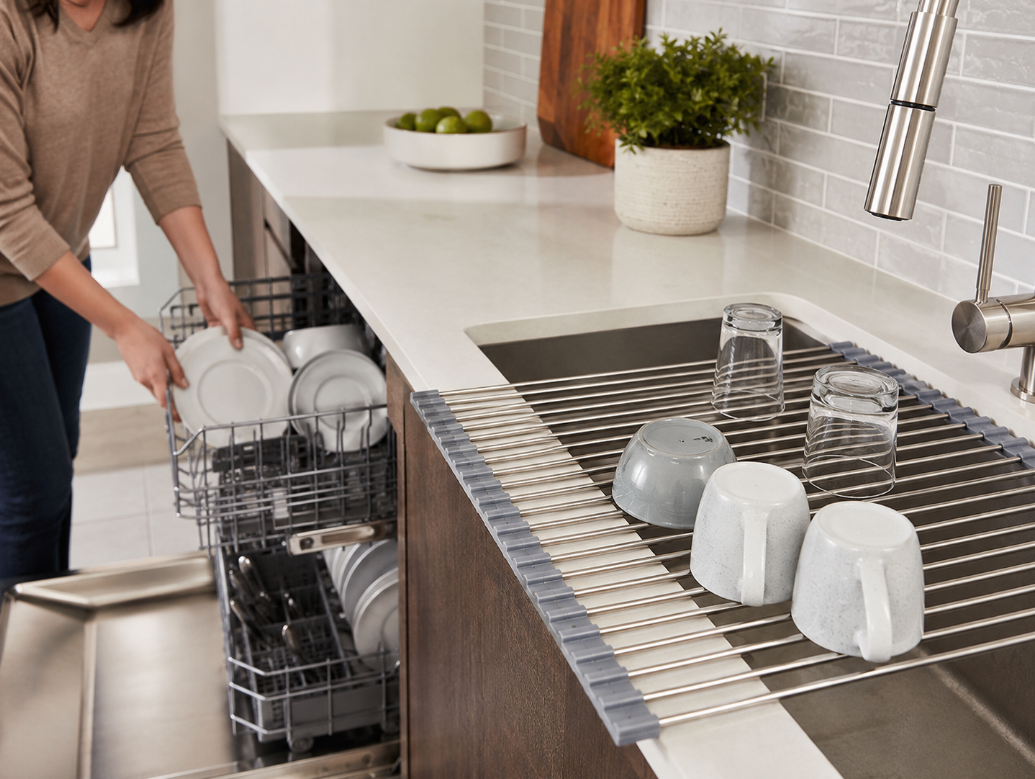
A Roll up Dish Drying Rack can be positioned across a suitable sink to provide temporary air-drying space.
It is useful for items that remain damp after the dishwasher cycle or for pieces that must be washed separately by hand.
A roll-up rack can provide:
Open airflow around wet items
Drainage directly into the sink
Temporary countertop workspace
Compact storage after use
Space for rinsed produce or small cookware
The rack should be sized correctly so both ends rest securely on the sink edges.
We produce round-tube, square-tube, and customized roll-up drying racks for household, retail, hotel, and kitchen-project applications.
Stainless steel components, flexible connectors, dimensions, tube structure, finish, and packaging can be adjusted according to buyer requirements.
Our factory also manufactures sink-bottom grids, fixed dish racks, drainage baskets, Cup Washers, and bathroom storage hardware, allowing buyers to develop coordinated kitchen and bathroom accessory collections.
Developing compact drying accessories for sink manufacturers, retailers, hotels, or home-improvement brands?
Provide the sink width, rack dimensions, tube shape, stainless steel requirement, finish, packaging method, and purchasing quantity. We will prepare a suitable Roll Up Dish Drying Rack quotation.