A plate, bowl, or glass may appear undamaged until it suddenly cracks during washing, heating, stacking, or everyday use.
The final break is often caused by earlier damage that was too small to notice. A light impact, sharp temperature change, pressure from stacking, or contact with a hard sink surface may create a weak point that grows over time.
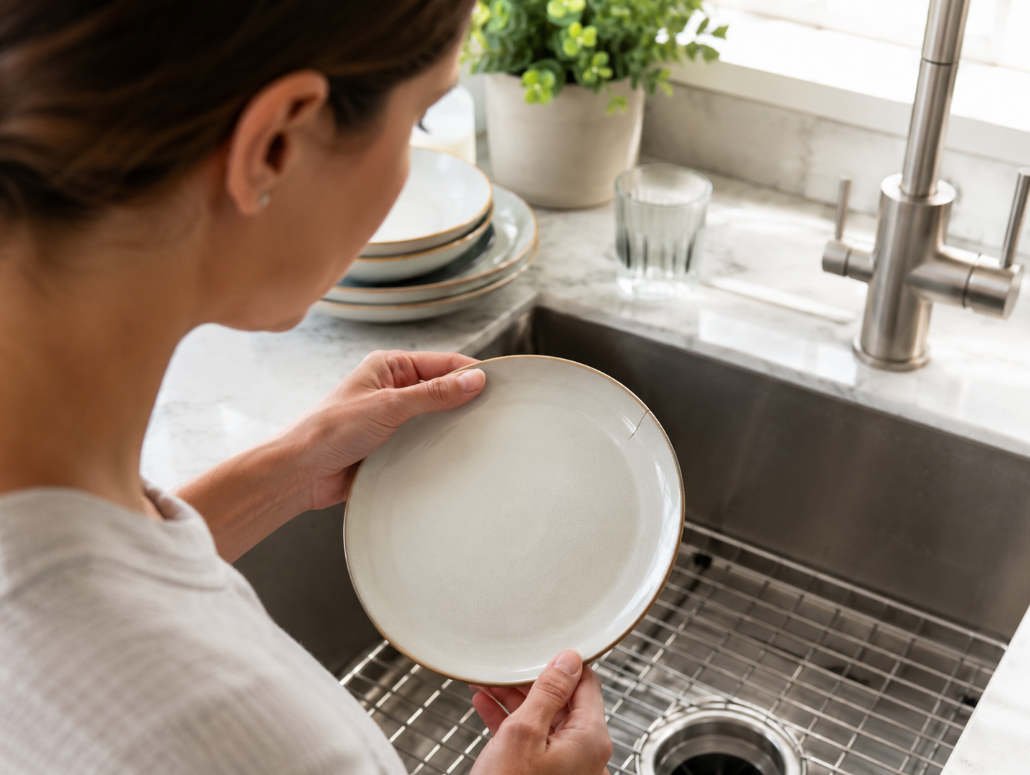
Fine cracks in ceramic and glass can be visible only under strong light or when the surface is wet.
A damaged dish may still feel solid, but repeated washing and temperature changes can cause the crack to expand.
Check the rim, foot, handles, corners, and decorative edges.
A rough spot, small chip, unusual line, or change in sound when the item is tapped gently may indicate damage. Dishes with sharp chips or unstable cracks should no longer be used.
Heat and water may make fine cracks easier to see.
Inspect delicate dishes after washing rather than immediately stacking them in a dark cabinet.
Moving a cold glass directly into very hot water can cause different areas of the material to expand at different rates.
The same problem may occur when a hot dish is placed on a cold, wet, or metal surface.
Allow refrigerated containers to warm gradually before washing them with hot water.
Do not pour boiling liquid into glassware unless the product is designed for that temperature. Allow hot cookware and dishes to cool before placing them in a cold sink.
Dishes may move slightly during a dishwasher cycle. When plates, bowls, and glasses touch one another, vibration and spray pressure can create repeated impact.
Place dishes between the rack supports rather than allowing them to lean loosely against one another.
Glasses should remain stable and should not touch nearby glasses, metal pans, or rotating spray arms.
Heavy cookware belongs in the lower rack, while suitable glasses and lighter items are generally placed in the upper rack.
Do not position a heavy pan where it can fall against ceramic or glass during the cycle.
A tall stack of plates places continuous pressure on the lowest items.
If one plate has a slightly uneven base or an existing hairline crack, the weight may gradually enlarge the damaged area.
Store similar-sized dishes together and avoid forcing oversized pieces into a narrow cabinet.
Shelves should remain level and strong enough for the weight of the stored tableware.
Ceramic, stone, quartz, and stainless steel sinks are durable, but their surfaces are still hard enough to chip delicate dishes during washing.
A plate may be damaged when it slips from the hand or strikes the sink bottom.
A Kitchen Sink Bottom Grid creates a raised support layer between dishes and the sink surface.
It can reduce direct impact, allow water to drain beneath dishes, and provide a more stable temporary resting area during washing.
The grid should match:
Sink length and width
Corner shape
Drain position
Bowl depth
Required clearance
Foot and bumper locations
A poorly fitting grid may move during use or block the drain opening.
Stainless steel 201 and 304 may be used for different product and market requirements.
The buyer should consider moisture exposure, cleaning products, required corrosion resistance, target price, and expected service conditions before confirming the material.
We manufacture quadrilateral, polygonal, circular, and custom sink grids for different sink shapes and drain positions.
Our internal development and production teams can review sink drawings or samples and adjust the grid dimensions, wire arrangement, feet, bumpers, drain opening, finish, and packaging.
Manual and semi-automatic production lines support both standard products and customized purchasing requirements.
Inspect tableware regularly, avoid sudden temperature changes, and load the dishwasher without allowing fragile items to touch.
When washing dishes by hand, place them down gently rather than dropping them into the sink. A correctly fitted bottom grid can provide additional protection, but it cannot make already cracked dishes safe to use.
Sourcing protective grids for sink production, retail distribution, or kitchen projects?
Send us the sink drawing, internal dimensions, drain position, corner radius, stainless steel grade, surface finish, and order quantity. We will prepare a Kitchen Sink Bottom Grid proposal for sample confirmation.